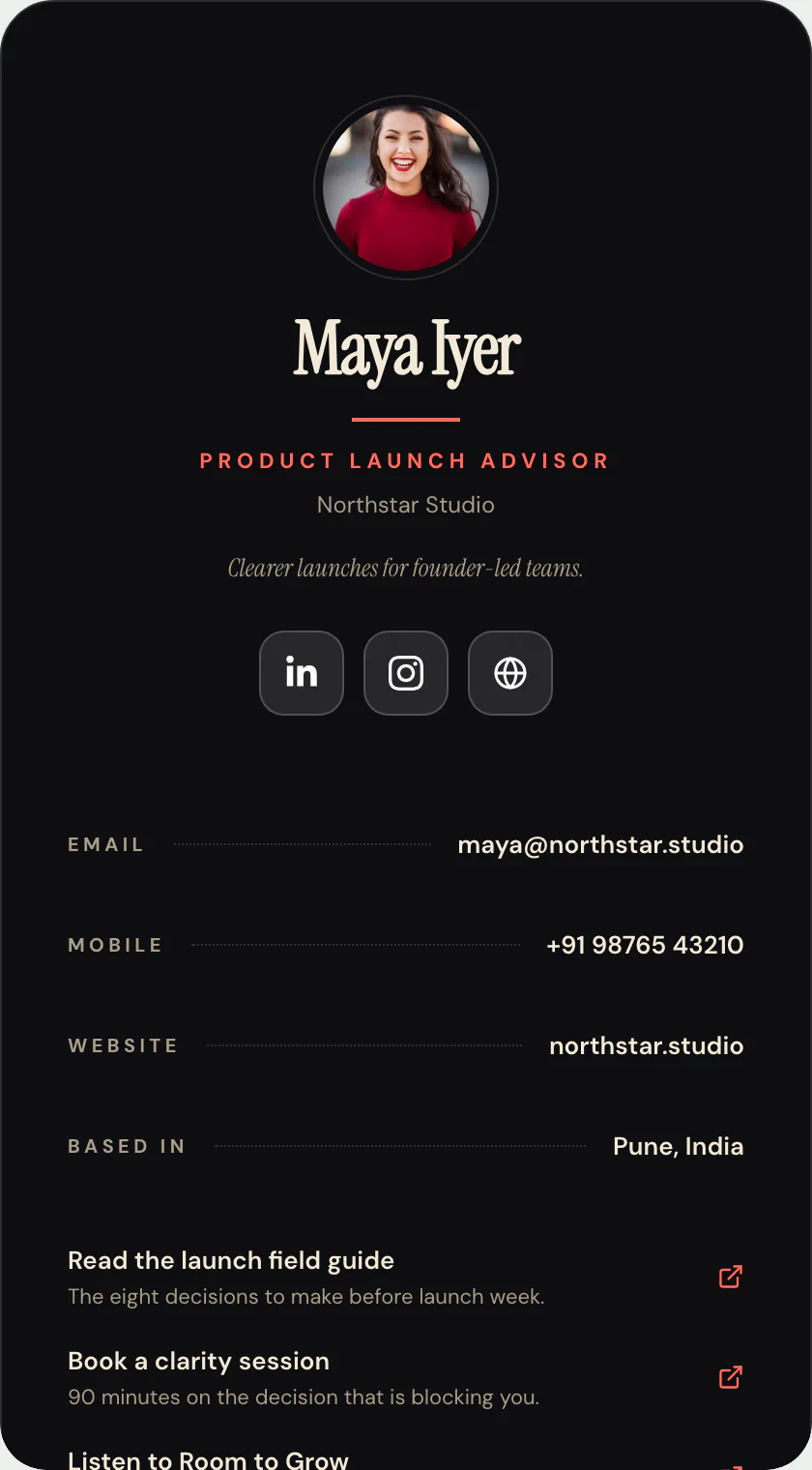
The link in your Instagram bio is opened by someone mid-scroll, usually because a post or story told them to. They arrive with a specific expectation and about eight seconds of patience. The page on the other side has one job: honor the promise that sent them.
Match the page to the post, not to your résumé
The most common bio-link mistake is pointing at a homepage — a general page about you, when the visitor came for a particular thing. If your last three posts mentioned a recipe, a discount, and a podcast episode, those three things should be the top of the page, in that order, with labels that repeat the words used in the posts.
This is why a link page beats a website homepage for social traffic, and it is the entire reason the category exists. The page is not your identity; it is your current answer to "where is the thing you mentioned?"
Order by this week's priority, not by history
A bio link page decays by accumulation. Every campaign adds a link, nothing gets removed, and within a year the page is an archive that buries the current priority under the previous eleven. Treat the page as a rotation, not a record.
If you run promotions, tag the links with UTM parameters so you can see which post actually moved people. Click counts on the page tell you less than source tags in your analytics.
- First link: whatever this week's posts point to
- Second: your one evergreen action — newsletter, booking, shop
- Third: at most one more current thing
- Everything older: removed, not reordered
Write labels a thumb can trust
"Links" is not a label. Neither is a bare domain. A good label names the outcome — "Get the March workshop recording", "Book a 15-minute intro call", "The gear list from Tuesday's reel". Labels like these convert because they remove the doubt about what a tap costs.
The same honesty applies to order: if the first link is an ad, say so in the label. An audience that learns your first link is always worth tapping is the most valuable asset a bio page can build.
When the link should stop being a list
There is a point where a link stack works against you: when visitors arrive not from a post but from your name — a podcast mention, a talk, a WhatsApp introduction. Those visitors want to understand who you are, and a stack of campaign links answers a question they did not ask.
That is the moment to graduate the link to an about page or, if you sell directly, a compact storefront — and it is why we built the link page as one format of a page that can change shape without changing its address. Whether Linktree's paid tier is worth it for your version of this page is a separate question; we ran that math in Is Linktree worth paying for?