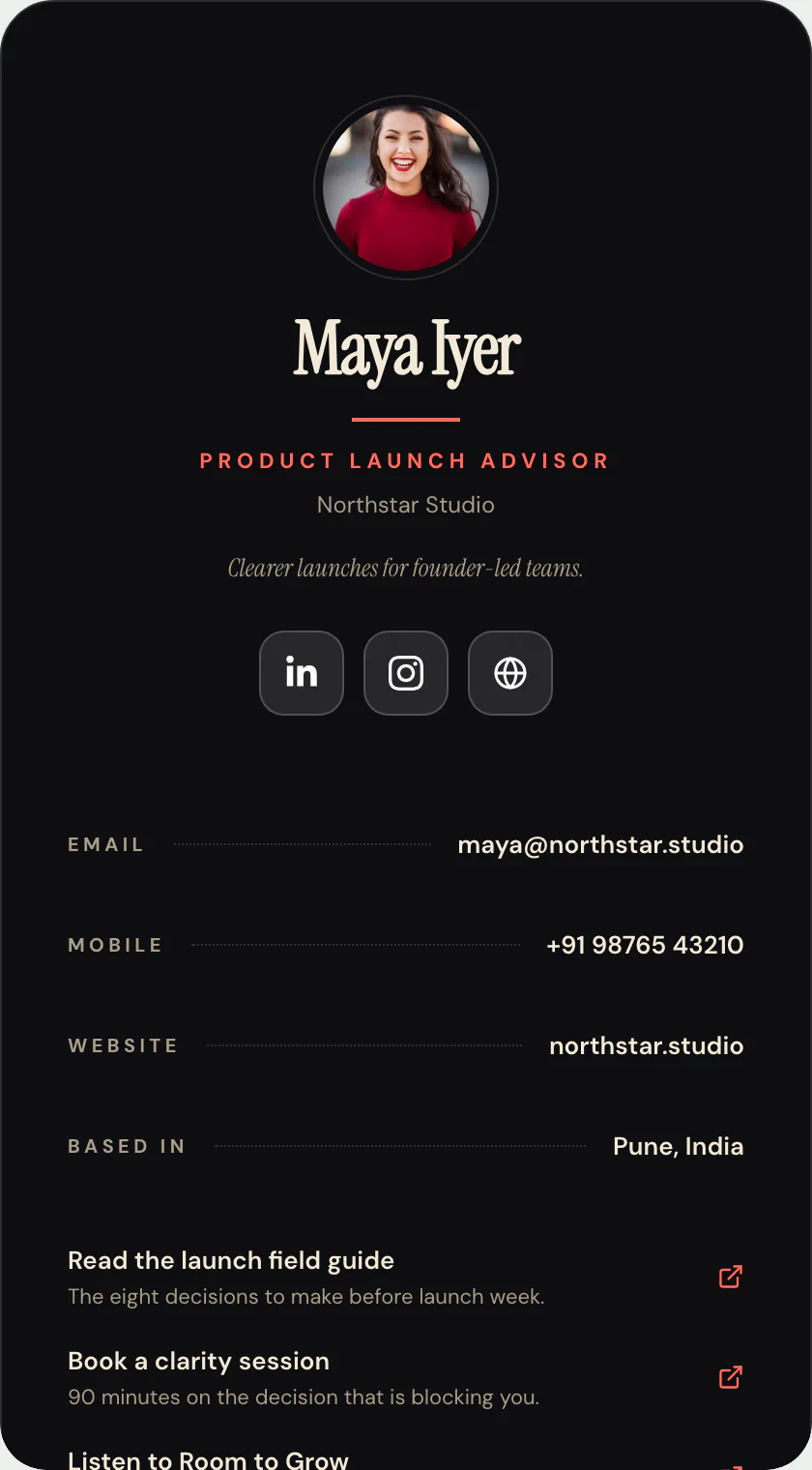
Every year the same obituary runs: business cards are dead, killed by QR codes, NFC, or whatever shipped last quarter. Meanwhile billions of cards get printed, handed over, and pocketed, because a physical object passed between two people still does something a link cannot. The obituary keeps missing the actual event. The card did not die. It got demoted.
What paper still does better
A paper card works with no app, no battery, no signal, and no explanation. It gives a first meeting a physical beat — the pause, the glance down, the pocket — that a screen tap does not replicate. In plenty of industries and most of the world, declining to carry one still reads as unprepared, and the card's texture and weight carry information about you before a word is read.
None of that has changed, and none of it is the part that stopped working.
The part that stopped working
The card used to be the record. You kept a drawer or a rolodex, and the card in it was where the contact lived. That job is gone. The record now lives in the phone, and a contact that is not in the phone effectively does not exist. Follow-ups happen in email and messaging apps, address books sync through platforms, and the paper card's information is stale the day your role or number changes — which is why the drawer full of cards is now a drawer full of people whose details you do not trust.
So the card was demoted from record to pointer. Its remaining job is to move your details from the meeting into the other person's phone with as little friction as possible, and a card designed as if it were still the record fails at the job it actually has.
Designing the pointer
A pointer card is judged by one metric: does your contact end up saved in their phone. That reframes the design brief entirely.
The expensive mistake is printing the full rolodex entry — office line, fax ghost, street address, three social handles — onto card stock. Every one of those fields is a future inaccuracy, and none of them helps the details reach the phone.
- Print less. Name, one line of context, and the bridge to digital. Every extra detail ages the card faster
- Make the bridge a QR code that opens something worth scanning — the difference between codes people scan and codes people ignore is covered in QR codes people actually scan
- Send the scan to a live page, not a static file, so the card you printed in January is still accurate in November
- Let the page do the saving: a proper digital business card offers a save-to-contacts action, which delivers a vCard straight into their address book
Where NFC and tap-to-share fit
NFC cards and phone-native sharing like NameDrop compress the same bridge into a tap, and they are genuinely pleasant when both sides cooperate. They also carry their own fine print — hardware costs, platform boundaries, the receiving phone's settings — which we go through in NFC business cards, before you buy and where NameDrop stops. The strategic point is the same either way: tap, scan, and paper are all just transport. The asset is the page they deliver.
Carry paper, spend on the destination
Carry paper if your world expects it — it is cheap, it works everywhere, and the ritual still opens conversations. But spend your effort on the destination, not the cardstock. One accurate page at a stable address, saved into the other person's phone, outperforms the most beautiful print run the moment either of you changes jobs. Pubtact's contact card is built to be that destination, and the paper card's whole remaining job is to point at it.